As a PCS manufacturer, we receive soul-searching questions from customers every day: "Why do we always encounter grid alarms when multiple PCS units are paralleled?" "Unbalanced load always occurs when units are paralleled in off-grid scenarios. How to solve it?" Today, we will dismantle the core limitations of grid-connected/off-grid parallel units from the technical roots, and how to use hard-core innovation to make these problems a thing of the past.
1. Grid connection and machine parallelization: coordination problems under the “rules” of the power grid
In grid-connected mode, PCS does not operate independently, but as a "part of" the power grid and strictly follows the dispatching rules, which determines the two core restrictions during parallel operation:
1. Rigid constraints on grid compatibility
The public power grid has clear “admission standards” for access equipment. GB/T37408-2019 clearly requires that the total harmonic distortion (THD) of grid-connected equipment shall not exceed 5% and must withstand ±10% voltage fluctuations. When multiple PCS units are running in parallel, if the control strategies are not synchronized, the harmonics output by each unit will be superimposed and amplified, which will not only trigger the power grid protection device, but may also affect the operation of surrounding precision equipment. More importantly, the traditional three-phase three-arm PCS is difficult to handle the zero-sequence current caused by a sudden increase in single-phase load, which can easily cause three-phase imbalance in the Taiwan area. This is also a "red line" that is strictly prohibited by the power grid.
2. Synchronization accuracy determines the life or death of the system
When running in parallel, all PCS must be "on the same frequency and in phase" with the power grid, just like they must keep up with the beat during a chorus. If the clock synchronization deviation exceeds 10 μs, circulating current will occur between the units, which may cause the power devices to heat up and age, or cause the equipment to burn out. However, the synchronization delay of traditional RS485 communication can reach millisecond level, which cannot meet the needs of medium and high power scenarios. In addition, the carrying capacity of the distribution network is limited. When multiple PCSs are charged and discharged at the same time, it is easy to cause reverse heavy overload in the station area, triggering the transformer protection trip.
InBev's solution to the problem: from "adapting the grid" to "optimizing the grid"
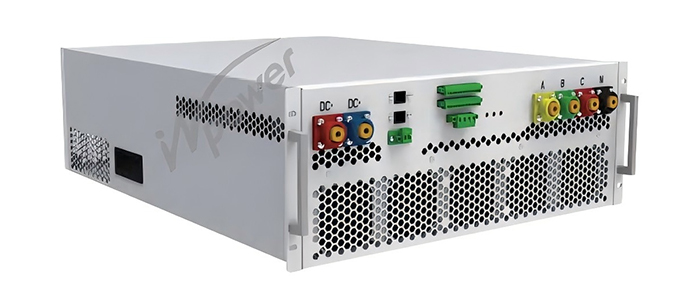
To address these pain points, our three-phase four-arm PCS provides a systematic solution:
(1) Dual control of harmonics and unbalance: Independent control of zero-sequence current through the fourth bridge arm (neutral bridge arm), supporting 100% three-phase unbalance, while controlling THD below 3%, far exceeding grid access standards.
(2) Microsecond-level synchronization technology: The power line carrier clock synchronization scheme is adopted to achieve local time calibration of each unit through beacon frame timestamps. The synchronization error is extremely small, which greatly reduces the risk of circulation.
(3) Grid-friendly control: Equipped with a self-developed phase jump compensation algorithm and four-quadrant operation capabilities, it can smooth out power impacts caused by fluctuations in real time.
2. Off-grid paralleling: “Autonomy Challenge” without network
In off-grid mode, PCS transforms from a "follower" to a "manager" and needs to independently construct a voltage and frequency benchmark. This makes parallelism exponentially more difficult. The core limitations are concentrated on two points:
1. Stability game of frequency and voltage
Without the power grid as a reference, multiple PCSs must work together to maintain system frequency and voltage stability. Traditional V/F control lacks inertia support, and the frequency fluctuation can reach more than 1Hz when the load changes suddenly, which can easily cause motor loads to stall.
2. Seamless requirements for mode switching
Industrial and commercial users have extremely high requirements for power supply continuity. Improper switching when the power grid is restored may cause voltage shocks, which may damage production equipment. The traditional PCS switching time exceeds 20ms, which cannot meet the "zero interruption" requirements of precision manufacturing.
InBev's solution: building an off-grid "virtual grid"
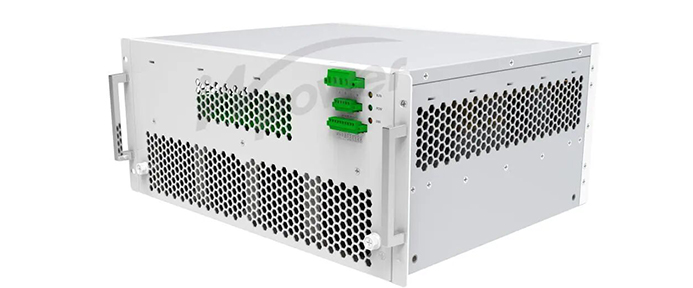
With network control technology as the core, we have created a highly resilient off-grid parallel system:
(1) Virtual synchronous machine (VSG) technology: simulates the inertia characteristics and damping characteristics of traditional generators, forming a "virtual grid" when multiple PCSs are paralleled, and the frequency fluctuation is stable when the load changes suddenly.
(2) 20ms seamless switching: With the self-developed STS module, off-grid switching is completed within 20ms when the power grid fails. When power is restored, voltage phase pre-synchronization is used to achieve impact-free grid connection, and the load does not flicker during the switching process.
3. From technological breakthrough to value implementation
As a R&D team that has been deeply involved in the energy storage field for more than ten years, we know that what industrial and commercial users need is not equipment that “can run”, but a system that “can save worry and make money”. InBev's 125kW industrial and commercial PCS has accumulated more than dozens of independent intellectual property rights, not only breaking parallel constraints, but also achieving full life cycle value upgrades: At present, industrial and commercial energy storage is shifting from "policy-driven" to "value-driven", and breakthroughs in parallel technology are the key to unlocking large-capacity, high-reliability systems. InBev Intelligent Storage provides overall solutions for green power, energy conservation and clean energy with technology, products and services.


